The making of a repetitive task
A behind-the-scenes look at making the customer journey.

Fig 1. The result of “hero” being taken too literally.
+21 mins reading, +36 images
I’ll just dive right into this mess of a post.
It’s what it took to bring this customer journey to life.
https://www.robotcompany.net/customer-journey-a-repetitive-task/
It’s behind the scenes.
There is no editing, the grammar is terrible, It’s the state of your kitchen after you cook up that storm.
It’s not for human consumption.
It’s a skim read at best.
I suppose, if you can’t wait, there are all sorts of scraps throughout about the business model.
Where do you get the time?
While it’s called a “company”, it’s going to be a hobby for a while.
I have a life and I’m making a family and I have a chunk of a company that requires quite a bit of attention.
I heard JK Rolling would sit on the train home from work and imagine Harry Potter… or something.
So, basically, I made the whole thing on the train to and from work (OK, like 20% was at home and actually needed a computer).
You can be quite productive with little more than your phone and a digital notebook.
Nonetheless, when I say “this took a week”… it means it took about 2-3 hours distributed across a week, with quite a lot of thinking time in between and various messages to a contract artist to do the heavy lifting.
Messages like this:
For the title page with the heroes flying out of the screen,
And then I would follow up with some links or images like this.

Original sketches
In July I threw down these sketches with the idea to produce a storyboard that would become the blog post.
Then later it would become a 3D animation or something. I don’t know if this user-story make it to that.

Finding contractors
Then I spent a week swiping for artists on Fiverr.
People told me to use Behance for this, but I’d recommend Fiverr first, then Behance if you need to get really niche in art.
( Why?: explained in some future post ) : Untitled
Anyway, I then built up this table in Notion of everyone who was interesting. I’m using Notion to manage this project for the time being.
( Why?: explained in some future post ) Untitled

The request
Then I put together the following on a notion page and shared it to each artist as a public link.
Why? : Because when one contractor has a question, you can update the content on the link and not need to go back and update all the other contractors.
Hi There. I like your work. Would you be interested in illustrating this user story for my blog? Its This is the blog:
The original specifications
This took about a week of thinking about it to get it right.
But… here comes a lot of text.
Most artists replied in 2 days. I got 3 or 4 enthusiastic offers.
Dear artist.
I’d like a colored set of images for the user story as written below. About 16 frames in total. I am flexible about delivery in case you might already be on a project. But a delivery in a couple of weeks would be nice.
The work will be on my public blog page here.
Below is the full user story and early sketches. After each section are artist notes (click to expand)
Overall artist notes
Propose a style of drawing that you are comfortable with, with reference to prior work. The time period is the present day (as in 2023, not retro or future) but the drawing style can be any style.
It is a user story about a robot in a modern workplace. The robot is depicted here below. with more pictures in this link

I can also get you other angles and poses for the robot as needed.
The exact proportions of the robot are not necessary for the artworks, but it should be clear it is the same robot as the other blog posts. I'd like to keep the same colour scheme for the robot (dark green, grey and gold/brass), but nothing else needs to follow those colours.
The robot has a base and detachable arms that can climb up on tables. As in this post
I plan to credit you as the artist.
You will be credited at the top of the public post for some time with a link back to your website of choice. This also will include price transparency. There will also be subsequent posts about the making of this user story which will include the draft sketches and the artists notes.
I am not suggesting this will lead to any sort of significant exposure for your work (I have very few followers), nor am I asking for a discount. The main reason is that part of the blog is to discuss the realities of small investments at an early project stage as well as to show appreciation to others that were involved. I hope this is OK with you. It's also fine if you want to use this work in your portfolio.
Finally, the user story text is still a draft and subject to minor changes that should not affect the images.
Please reply with price estimate and at least one link that shows what drawing/illustration style you would prefer to do the work in.
Looking forward to working with you.
/Dave
p.s. You can email me directly at dave ^^ robotcompany.net
User story: A somewhat repetitive task
If you want to have a product, you better have a few good user stories. Here is one.

Figure 1.1: a somewhat repetitive task
The storyboard artworks here are provided by <credit here>: <link to site>. The cost for the work was about <price here>usd per image.
The customer

Figure 2.1: the customer.
The customer needs a set of 500 boxes (metal cases) assembled with a circuit board in each box.
Just put this ready made circuit board in the box and close the lid.

Figure 2.2: the box

Figure 2.3: it doesn't matter what the box does
The customer decides to order a robot to perform the work.
Why do they decide this?
I’ll have a dedicated post about market segments coming soon. Untitled
The robot: as a remote-controlled vehicle

Figure 3.1: the hero of our story.
Artist notes
A hero shot of the robot. An upwards angle shot with arms “folded”. A bit like a cheesy linkedin profile shot. For example, holding some aviator sunglasses. Behind is a window to a blue sky (since the robot doesn't go outside, the window is the best chance of a hero shot)
Note: it turns The robot can’t actually fold its arms. Its a angles thing. The below pose might be a good position
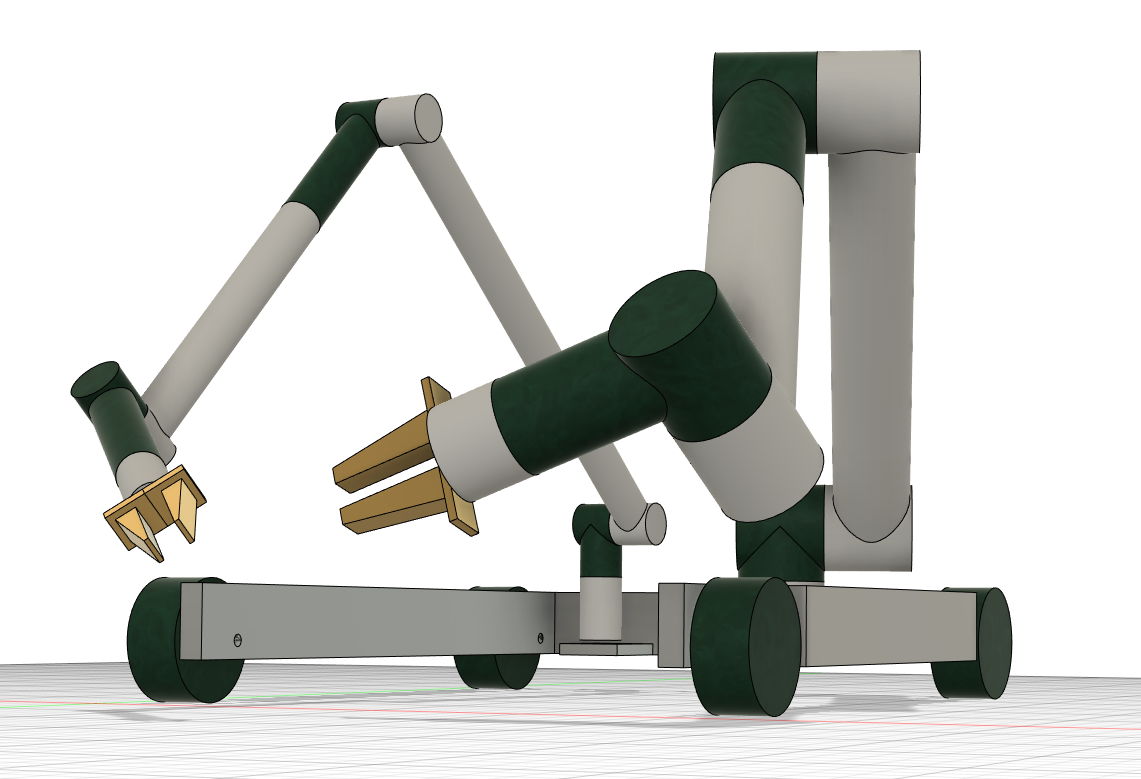
The robot, as described in other posts, is not in itself intelligent. It doesn’t have any sort of AI core. It’s not even internally programmable. It relies entirely on remote control and a link to a trusted operator. It is a Remote Controlled Vehicle.
This design choice is different from other applications where reaction time is critical for safety and stability, for example, in automated logistics (self-driving vehicles and delivery drones, etc.).
It is also different from typical factory automation where the goal is to achieve one repetitive task with the highest throughput possible.
It is rather like Robot-Assisted Surgery with a wider range of functions. The use cases are likely to differ every day and it’s not always easy to get the right person onsite for the job. There will also be a lot of exceptions where experience will become valuable.

Figure 3.2 The robot is entirely designed to be controlled remotely
Additionally influencing the design decision are a number of predicted technical, social and regulatory factors.
These will be linked here later.
For now, it’s enough to understand that the robot is not really capable of being self-autonomous on its own. It relies on a suite of cloud services in order to do anything practical.
By some definitions, that’s not what a robot is. I’ve drafted a post titled, “Well what is it then?”, but it's some way from being grammatically readable, (or even necessary, you pedantic… mumble mumble)
The operator

Figure 4.1 The usual suspects
From the customer’s perspective, the operator is:
The person who makes the robot do the work for me.
In the full customer journey, there will be interaction with a number of people representing the operator.
This is similar to a network operator, i.e.: the company that we just take for granted to make the phone and internet connection work.
And, like its network equivalent, the robot operator is more than one person or even one company.
Details on the internals of the operator will come in Untitled
For now, we will just use the operator for all these job roles.
Sales
The customer calls the operator to discuss their requirements. A reference video of assembling a single box is made. The operator will then put together an estimate for the work and set up a team for the task.

Figure 5.1 The sales person. Doing sales… person…things…yes.
If all goes well, the customer will order a robot to come and do the work.
Getting started
The robot is delivered to the customer's site.
The customer and the operator make a video call to do the setup.
Using this video call and the robot's onboard cameras, the robot is driven to the workstation.

Figure 6.1 Driving to Work
Artists notes
The Robot Driver is at their desk in the operations centre with two screens and an audio headset. A VR headset also sits on the table.
They are holding a game controller. Now it is important that is it in the picture
The 1st screen shows the first-person view of the robot driving along the floor. The image is from a camera mounted on the back of the robot. In this case, the arms are folded down to the resting position so as not to obscure the view.
This would be the shot from the robots perspective as if a camera was mounted over its back wheels.

The 2nd screen shows the video call that the robot driver is having with the customer The customer uses the back camera on their phone to view the robot moving toward a desk. In the bottom corner is the thumbnail image of the robot driver’s own face. as would be the case on a typical video call. This also communicates a human face to the customer’s video call (which is shown in the next image)

This is how the customer might see the robot. Note where the camera is on the back wheel.
The robot moves into position at the customer work area. In this case, it mounts itself up on a desk space (as shown here)

Figure 6.2 Getting into position for work
The customer's role is then basically complete and they can then shift their attention to other things.
The robot carries some extra portable cameras. They are placed by the robot as necessary to get a good view of the working area.

Figure 6.3 Setting up a good view of the task
The operator controls the robot to begin the task. In this case, assembling the electronics boxes.

Figure 6.4 Doing physical work remotely
Process optimization
So, behind the scenes, there is actually an entire team of experts overseeing the task that is being performed.
Dave, that sounds very expensive!
Anyway, some robot drivers perform the work.
In parallel, some process optimization engineers will work to break down the task into simple subtasks. They will use their experience and a library of solutions to have software automate as many of these subtasks as possible.

Image 7.1 optimising while working
The cost per unit will drop dramatically. This saving is transparent to the customer in real-time.
The remaining work might be too complex for instant automation.
In this case, the more difficult subtasks are now distributed to a number of other human-robot drivers in order to set up an efficient work chain that can be monitored and further optimized. It’s not exactly a new concept.
Optimized how?
Well, of course, now we start making all the big statements on AI-based training solutions, Here is Sam Altman explaining why it might be too early to be making AI on robots.
“It turned out to be a mistake… it turns out that robotics is a very hard environment. Robotics is hard, and it's not hard because the machine learning is hard, it's hard because the simulator is bad, the robot breaks, you can't run it that fast, like you know, you don't have like hundreds of thousands of robots like you have hundreds of thousands of CPUs to run a game on… someday we'll get back to it - Sam Altman in an interview with Guy Raz
He said it perfectly, so I’ll spare you my take on it… only to say that there is a long post-in-the-making on the realistic way that AI adds value to this type of user story.
I had to cut a lot of material about the future of AI here in order to stay on topic.
Furthermore, such services could also be further contracted to third parties with specialised capabilities. In this case, the operator plays a key role in managing the privacy of the customer. This is why the chips are pixelated in some of the images.
For now, we just say the optimizers use a combination of normal automation techniques, like software libraries and algorithms, in order to automate all or most of the process. There will probably be a number of specific AI-trained models here and there to get common subtasks done efficiently.

Image 7.2 A contractor inspects their work while the customer’s proprietary data is kept safe at the same time.
Following the sun

Image 8.1 24/7 operation becomes easier for small businesses
As the first day of work comes to an end, the customer goes home, but the robot has the option to stay on and work the entire night.
At the operator, the remote work is simply handed to the next time zone around the globe. This enforces proper documentation of all work and provides opportunities for review of the processes that have been put in place.
This way of working is similar to global network operations centres (GNOC) which large operators already run today.
Completion

image 9.1 success
Artist notes
The robot, now back on its base with its arms up denotes some sort of success. Some completed metal boxes are stacked near by. Maybe kinda cheesy or fun looking like a sunset. I don’t know. Artists discretion.
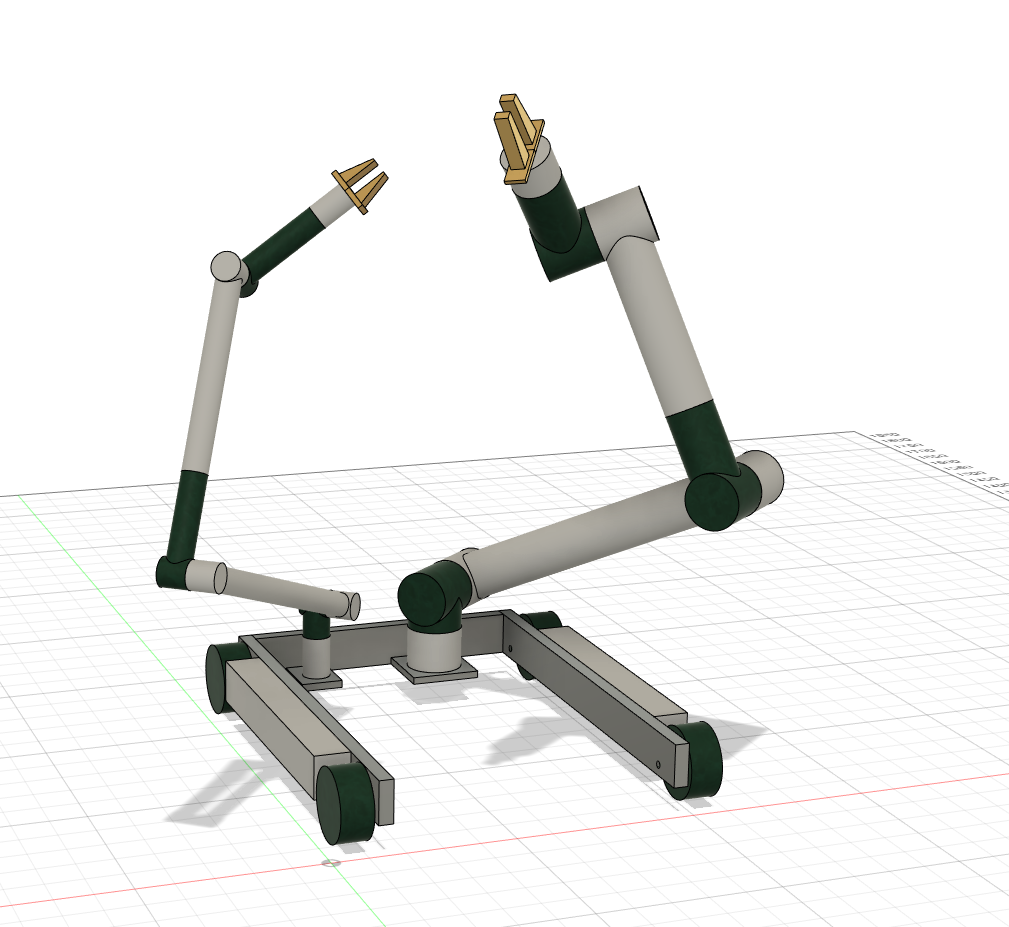
After some days and nights, all 500 boxes are complete. The robot then returns to its shipping box (or goes on to the next task)
As part of the service, a full recording of the production and a photo record of every unit is then sent to the customer for review and traceability.
Central to this user story is the idea that the level of high-cost human involvement drops down to the level of monitoring and exception handling. This is a very standard for modern manufacturing. The main difference here is that it’s on a smaller and quicker scale with a much lower setup investment than full automation.
Hopefully, this user story also introduces some other managed service type values as well. In short, there is potential to bring large-scale automation services to small-scale operations. This will be discussed in more detail later.
So, the robot company is the operator then?
Sometimes.
But there are also many existing operators in similar fields. These businesses already have most of the needed infrastructure. The most important of which is the ability to manage service-level agreements and local government regulations.
In this case, Robot Company provides and maintains the robot itself as well as the platforms for controlling it. It is a manufacturer and supplier of the technology.
And, of course, more on this later.
.
The Results Page 1
After discussions with a number of artists I selected wilustrador.
He recommended we start with one page first to see if we would work well together.
This is the early results.

I love the early sunglasses, but they were just a little too cool for school.
The boxes also needed a lot of work.


And then the rest
It took a couple of weeks to get the first page right. But, I was really happy with the results.
We then agreed to go forward with the rest. this took about a month.
I’m was quite surprised how well the artist brought the whole thing to life and understood all the the details in the text. It was a lot to take in.

Still, there were a lot of small details that needed to be addressed. Its really hard to know what doesn’t communicate well. For example: the robot goes to a desk. This sketch seems about right. But, the picture in my head was an empty desk for assembling parts.
Here’s the note for the middle left frame
notes on 6.2 this is the customer character. No headset. No chair, they are standing. They are looking a the screen and pointing at the robot, their thumbnail is the mirror image of their own face. For the desk. I need it changed to the “low desk” shown in figure 5 of https://www.robotcompany.net/quick-model-update/ In this case we don't have a screen or keyboard or mouse. Instead, there should be some un-assembed boxes on the desk. ie: some circuitboards and some empty box-cases. These should be to the side. In this case the robot is fine as is, and is about to go under the desk.

Fiverr also has a great tool for letting you set comments directly on specifics in the image.
In the end, this became the best way to get a lot of changes made quickly.

ok so lets go to colour!
Another time-consuming challenge came when colocolouringuring.
At one point everything looked like it a 70’s colour pallet of yellows and browns.

I had a lot of second-guessing at this point.
Its kinda cool right? How does one judge this?
I’m not an artist, i don’t know. I never put a lot of thought into the colours.
Things like this takes time to walk away and come back and articulate a change.
then came the blue period.

This really melted my brain.
But, eventually we got there.
Even when we finally got to the colours, I had no idea that it actually looked good.
final works
The finals can be found in the customer journey post, of course,
https://www.robotcompany.net/customer-journey-a-repetitive-task/
Here is the the side-by-side version with the original sketches to show how far it came.


Next steps
Ultimately, it’s about putting down one small brick at a time and then building on top of what you have. Coming soon is a post about where I might go from here.